The private sector is a powerful and vital partner in realizing integrated land-use strategies that reduce emissions, lift local communities out of poverty, and grow sustainable economies. The ISFL is committed to working with the private sector to achieve transformational change in all its programs. Transitioning to low-carbon, climate-resilient development pathways requires more than public funding from bilateral sources, multilateral development banks, and climate funds.
|
The low-carbon future the ISFL envisions requires significant investment and innovation as well as a fundamental shift in how governments and the private sector make decisions and implement activities across landscapes. |
These programs and sources of funding can play a critical role as vital catalysts for this sort of change through the effective engagement of private sector actors. To transform current development pathways into ones that are climate-resilient, the private sector must play a larger role.
The ISFL has worked with participant countries to develop private sector strategies that aim to work with and through existing platforms, thereby allowing the ISFL to serve as a convening force, crowding in private sector funding.
These strategies seek to support public-private partnerships and dialogues to address barriers to private sector investment and bolster activities that attract additional private sector investment or matching investments. Proposed activities for ISFL investment are premised on supporting high-impact scalable programs, with the participation of the private sector, that can transform rural areas by protecting forests and biodiversity, restoring degraded lands, enhancing agricultural productivity, and improving livelihoods and local environments.
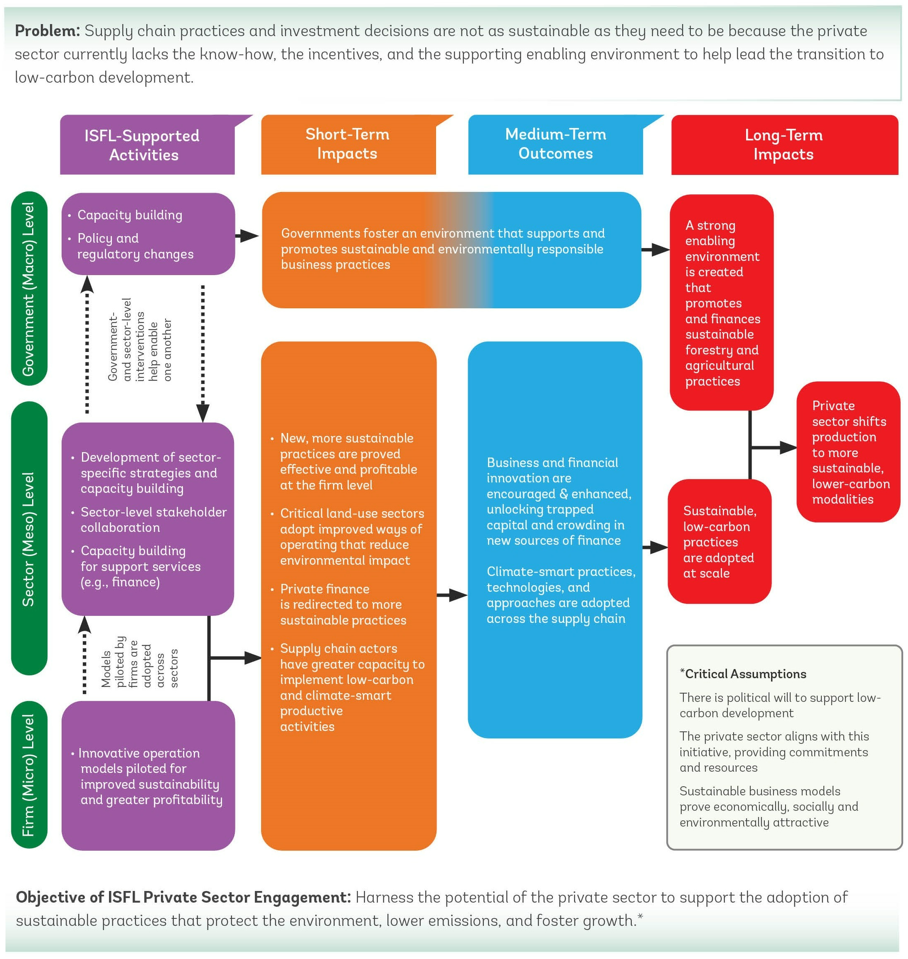
To further this goal, the ISFL has created a comprehensive Private Sector Theory of Change. The purpose of the private sector Theory of Change is to provide a way of considering the critical pieces required to adopt sustainability in agricultural development of a jurisdiction, where adoption of sustainable practices is enticing for farmers, traders and agribusinesses. This requires a joined-up approach where all critical parties work collectively to make sustainability the best path forward. For an in-depth exploration of how the ISFL has put this theory into practice, see the FY22 ISFL Annual Report.