By Nkulumo Zinyengere, ISFL Fund Manager
With the launch of the 2026 ISFL Annual Report, we take the opportunity to reflect on what we have achieved across our country programs and how the program is moving into a new phase defined by verified results, carbon market transactions, and compounding benefits for communities who depend on forest landscapes and farming for their well-being.
Over the past fiscal year, Ethiopia became the first country to have verified emission reductions issued under the ISFL. The Oromia region’s first monitoring period generated 14.9 million tons of verified emission reductions, with 12.4 million available for transacting. These reductions have the potential to generate $150–$200 million in revenue for the region and its communities. Beyond the figures, Ethiopia’s achievement provides a proof of concept. It demonstrates that a large-scale, jurisdictional approach to reducing land-based emissions can deliver results at scale by integrating forestry, sustainable agriculture, and community livelihoods.
Ethiopia also illustrates how the Emission Reductions Purchase Agreement (ERPA) can give countries greater certainty about the price they will receive for their emission reductions, by acting as a floor price. This helps reduce the financial risk of developing the program and makes the credits more attractive to private sector buyers. CORSIA-eligible credits generated under the program have attracted significant private sector interest, demonstrating how donor finance can mobilize private capital and create new, sustainable revenue streams. Those revenues will flow back into rural economies to deepen development outcomes such as resilient livelihoods, increased income and employment opportunities, and further emission reductions. This is the model that the World Bank's Scaling Climate Action by Lowering Emissions (SCALE) fund is designed to carry forward, using public finance to reduce the risks for private investors and attract private capital at scale.
Progress across our other country programs this year is also encouraging: Zambia submitted its first emissions reductions monitoring report, paving the way for another ISFL issuance next year amid growing private sector interest. Colombia and Mexico finalized commercial terms for ERPAs, with both countries making key strides toward signature. Indonesia’s grant program ended this year after surpassing its sustainable land management targets. The program is exploring alternative structures to monetize generated emissions on the carbon market, including through a transition to an external carbon standard.
What has struck me most this year is the compounding nature of the progress we are seeing. The fund’s cumulative results include 14.9 million tons of verified emission reductions, more than 190,400 people reached with benefits, and 13.8 million hectares under sustainable management planning. These outcomes reflect years of patient, systemic work, requiring changes in farming practices, community engagement with forests, government policies and institutions, and sustained donor support. They are also contributing to more resilient livelihoods, increased incomes, and employment opportunities for people who depend on forests and agricultural landscapes for their well-being.
What the ISFL continues to show is that when communities are engaged fairly, government capacity is strengthened, the right financial incentives and policies are in place, and the private sector is engaged effectively, jurisdictional landscape programs can deliver large-scale emission reductions, improved incomes, stronger livelihoods, and greater resilience for hundreds of thousands of people.
We are grateful to our country partners, our donors, and above all the communities who have made this year’s progress possible. We are more confident than ever that the ISFL can serve as a model for climate action at scale, using public money and carbon markets to generate sustainable benefits for people and the planet.
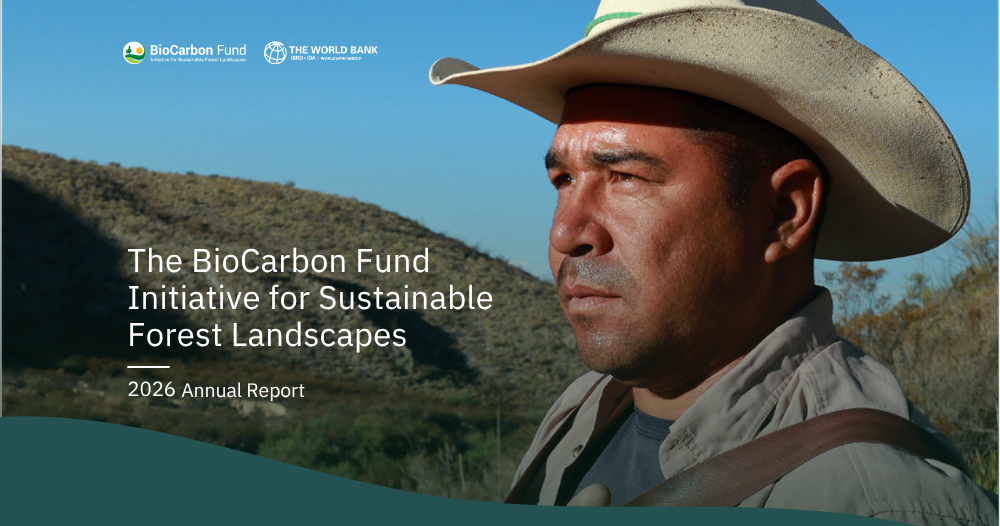
Download ISFL’s 2026 Annual Report
ISFL 2026 Annual Report: Turning Results into Carbon Finance
30 September 2026
ISFL 2026 Annual Report: Turning Results into Carbon Finance